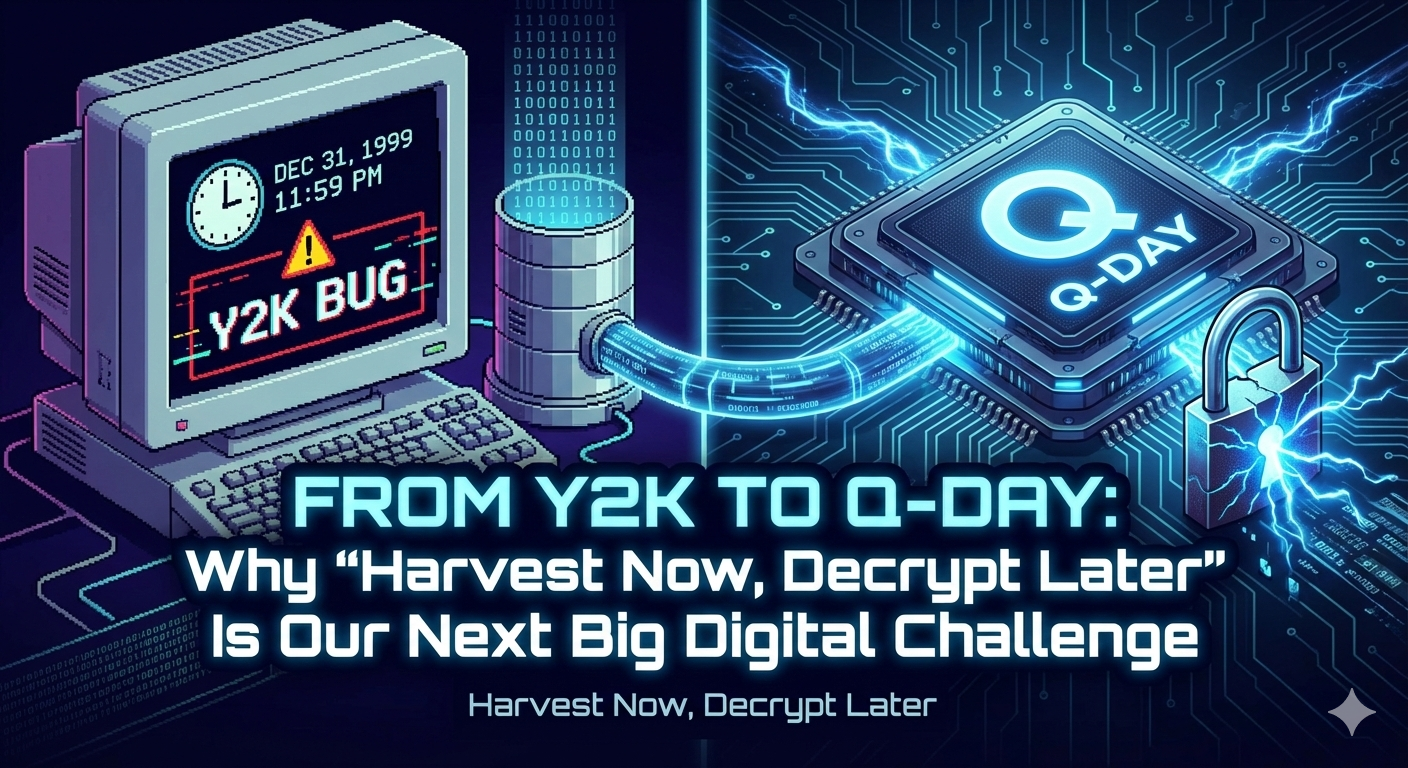
Sometimes referred to as “The Quantum Apocalypse”
Remembering Y2K
The Y2K (aka “Year 2000”) incident of the late 1990s represented a critical technical challenge. Computers were programmed to store years as two digits (99) instead of four (1999) to save memory. When 2000 arrived, systems would interpret “2000” as 1900—since “19” was static with only two dynamic digits—potentially causing widespread failures in banking, power grids, and global infrastructure.
The world spent billions preparing, and disaster was largely avoided through proactive measures.
Today’s Threat: Harvest Now, Decrypt Later (HNDL)
Today, we face a similar but more insidious threat: Harvest Now, Decrypt Later (HNDL) attacks.
Malicious actors are currently collecting and storing encrypted data—financial records, state secrets, personal information—even though they can’t decrypt it yet.
Why?
They’re betting on quantum computing’s inevitable advancement.
What Is Q-Day?
Cybersecurity analysts call this upcoming threshold “Q-Day” or Quantum Day—the moment when quantum computers become powerful enough to break current encryption standards like RSA and ECC. These mathematical problems have kept humanity’s private data safe for decades, but on Q-Day, everything could become vulnerable.
Unlike Y2K’s fixed deadline, Q-Day has no definitive date, making preparation even more challenging.
The Invisible Danger
What makes HNDL particularly dangerous is its invisibility. Data being harvested today could be decrypted years from now—or maybe sooner than we think—exposing information we thought was secure.
Everything encrypted with current standards becomes vulnerable once quantum computing reaches sufficient maturity.
How Close Are We?
With quantum chips like Majorana 1, Willow, and many others, tech giants including Google, IBM, and Microsoft are already developing increasingly powerful quantum processors, bringing Q-Day closer than many realize.
The threat isn’t theoretical or distant—it’s getting closer.
The Race Against Time
Cybersecurity companies and researchers are racing to develop and implement quantum-resistant encryption protocols to protect:
- Banking systems
- Healthcare data
- Government communications
- Critical infrastructure
The goal? Secure these systems before quantum decryption capabilities become a reality.
Leave a Reply